
16 Sep 2026
For a long time, growth has been treated as the obvious goal of running a business.
And, in many cases, it makes sense.
But there is a question that doesn't get asked often enough in the bike tour industry:
What if bigger isn't always better?
We recently asked our group of independent bike tour operators exactly that question: Is growth always the goal, or is there such a thing as the perfect size for a bike tour company?
The answers were more interesting than a simple yes or no.
Some operators are actively looking for ways to grow.
Others are doing almost the opposite.
And there is something worth paying attention to there.
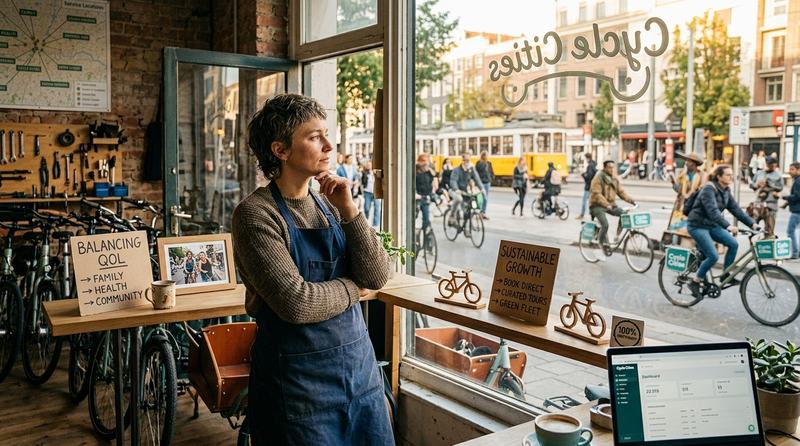
More bookings can mean more revenue.
But they can also mean more guides to manage, more bikes to maintain, more customer service, more logistics and, eventually, more overhead.
A bigger shop might allow you to handle more customers. It might also mean higher rent and more staff sitting there when there are no groups arriving.
A larger fleet gives you more capacity. It also gives you more bikes to maintain, store and replace.
Hiring more people can help you take on more tours. It also creates a bigger team to coordinate and a bigger payroll to manage.
None of this means growth is bad. It just means growth isn't free.
And sometimes we forget to ask whether the extra revenue is actually worth the extra complexity.
This was one of the most interesting points to come out of the Symposium discussions.
Some operators talked about deliberately scaling back parts of their business.
One example was reducing or even removing bike rental operations because of the fixed costs attached to them: shop rent, mechanic costs and the overhead of maintaining a service that wasn't necessarily delivering enough value.
Others described a much leaner approach to physical locations.
Instead of keeping a shop open throughout the day, they only open it when groups are arriving or departing.
That's a very different way of thinking about growth.
The question isn't: "How can we sell more?"
It's: "What do we actually need in order to run a healthy business?"
And sometimes the answer is less than you think.
There is another idea here that I find particularly interesting.
Maybe there isn't one definition of a successful bike tour company.
One operator might want ten guides and hundreds of tours every month.
Another might prefer a smaller team, fewer tours and higher margins.
Someone else might want to build a large fleet and become a major player in their city.
Someone else might be perfectly happy running a lean operation that gives them more freedom and less overhead.
All of those can be good businesses.
The problem starts when we assume that the first model is automatically better than the second.
If your business generates enough income, gives you the lifestyle you want, keeps your team happy and leaves you with a healthy margin, why should you feel pressure to make it twice as big?
That's a genuine business decision. Not a lack of ambition.
This sounds obvious, but it's surprisingly easy to lose sight of.
Imagine you increase your bookings by 30%.
Sounds great.
But to make that happen, you also need:
more guides, more bikes, more maintenance, more marketing, more admin, more space, more management.
If those costs grow faster than your profit, you've built a bigger business without necessarily building a better one.
This is why some of the operators in the Symposium discussions talked about shifting their focus toward margin and price once customer growth reaches its limits.
Instead of trying to sell more and more tours, they look for ways to make the existing business more valuable.
That can be a much more interesting growth strategy than simply adding volume.
Maybe we need to broaden the way we think about growth.
Your business can grow without necessarily getting bigger.
Your margins can grow. Your direct bookings can grow. Your repeat customers can grow. Your reputation can grow.çYour team's skills can grow. Your operational efficiency can grow. Your ability to predict demand can grow. Your independence from OTAs can grow. Your confidence as an owner can grow.
None of these necessarily require another 20 bikes or another five guides.
In fact, some of them might become harder if the business gets too big too quickly.
This is another part of the conversation that often gets missed.
A business doesn't exist in isolation.
There is usually a person behind it who decided to start it in the first place. And that person has their own definition of success.
Maybe they want to build a company that can eventually run without them, they want to create jobs, to become the biggest bike tour operator in their city. Or maybe they simply want a good business that gives them enough income and enough time to enjoy their life.
There is nothing wrong with any of those goals.
But they lead to very different businesses.
So before asking "How do I grow?", perhaps the better question is:
"What do I want my business to give me?"
That answer should influence the business model.
Not the other way around.
This is probably the biggest idea I took away from the discussion.
Growth shouldn't be something you pursue simply because that's what businesses are supposed to do.
It should be a choice.
If adding another tour makes sense, add it. If opening another location makes sense, explore it. If hiring another guide improves your capacity and your margins, great.
But if the numbers don't work, or the extra complexity isn't worth it, there is nothing wrong with staying where you are.
And if the right decision is actually to remove a service, reduce your opening hours or make the business leaner, that can be growth too.
Just a different kind.
There probably isn't one.
The Symposium conversations didn't produce a magic number of bikes, guides, bookings or cities that defines the "right" bike tour business.
And that's probably a good thing. Because the right size depends on what you're trying to build.
It depends on your city. Your customers. Your team, margins, seasonality, personal goals. Your tolerance for complexity. And, honestly, how much of your life you want the business to occupy.
That's why I think the question "How big can we become?" is sometimes less useful than: "How good can we make this business?"
Maybe that means getting bigger, leaner, charging more for a better experience, building a team that can operate without you, having fewer customers but better margins. Maybe it means simply building a business that you still enjoy running five or ten years from now.
There is no single right answer.
And perhaps that's the point.
Growth is a tool. It isn't the definition of success.
The better question for an independent bike tour operator might not be "How much can we grow?"
It might be:
"What kind of business do we actually want to build?"